r/modesofinquiry • u/EngagedBrain • Jul 25 '19
Young Americans demand civic education — for good reason

1
Upvotes
r/modesofinquiry • u/EngagedBrain • Jul 25 '19
r/modesofinquiry • u/EngagedBrain • Jan 27 '19

r/modesofinquiry • u/EngagedBrain • Nov 15 '17
If we all experience and understand time differently, how are we able to come to a consensus on a moment in time?
Please remember to take your time answer these questions - they are 10% of your grade
r/modesofinquiry • u/EngagedBrain • Nov 15 '17
How do you think about the past? Are your memories organized a particular way, how do you approach remembering things from different parts of your life? What is your first memory? What is your earliest ‘vivid’ memory?
Please remember to take your time answer these questions - they are 10% of your grade
r/modesofinquiry • u/EngagedBrain • Nov 06 '17
Does knowing about problems like our misunderstanding of future selves and planning fallacies help you? Or, does knowledge of a cognitive bias do little to correct the bias?
r/modesofinquiry • u/EngagedBrain • Oct 22 '17
Where is your time horizon? How far ahead do you plan? How far into the future do you feel is concrete? How or why might people have different time horizons and how might that create conflict?
Please fill out this survey
r/modesofinquiry • u/EngagedBrain • Oct 17 '17
Make a schedule
Describe 2 aspirations you have for your life 13 years from now.
Describe what you need to do to reach those aspirations in the mean time.
Experiential Component
A: Spend a day with your time perspective opposite In this experiential project you will need to find a partner with a different time perspective profile. You will interview this person (or each other if both of you are taking this class), so that by the end of it you should have some idea of the ways in which the two of you differ because of your time perspective. You don’t need to be different on everything – in fact, there should be some similarities – but you should be able to identify some key differences that can be explained in light of your different time orientations and spend some time becoming acquainted with the daily life of your partner. In order to accomplish that, each of you must spend a minimum of three hours following the other person around as they go about their usual activities. You may choose to do this at any time during the day, and at any point during the week. You might want to make this choice based on the time perspective on which you’re focusing.
In your 3-4 page paper describe not only the activities in which you engaged, but also describe your reactions, feelings, and cognitions while “living your partner’s life” for that brief period, and discuss how their life differs from yours because of their different time perspective. You could also discuss how this experience changed your opinion of your partner’s time perspective, if it shed any light on your own decisions, and whether it might change any of your choices.
B: Change your time perspective for 5 days This project gives the opportunity to change some element of your time perspective for a week. First, you need to determine the most distinctive, influential aspect of your time perspective profile: the single orientation that most makes you who you are. Then you’ll need to decide how you want to alter it. During the five days for which you are engaging in this experience, you should try to alter a variety of facets of your life according to your change in time perspective. You should alter your social interactions, behaviors, choices, cognitions, decision-making processes, interpretations, emotions: in short, everything that your normal time perspective influences. You will need to keep a diary of your experiences and reactions during the project. You should make an entry at least every day, and talk about how your altered time perspective influenced your life that day. When you turn in your 3-4 page paper, you will need to attach this diary to it. Your paper should discuss the elements listed above: both your experiences and your reactions, in regard to each of the ways in which you changed your life for five days in accordance with your new time perspective. Please also reflect on how this experience has shed new light on your normal life, and whether it has convinced you to make any changes in your normal behavior and choices.
r/modesofinquiry • u/EngagedBrain • Oct 02 '17
#CTR
Post to OneNote
# Engagement
Post to reddit
What are all of the ways that you can be engaged in the 1) Loras intellectual community 2) your personal learning 3) this class?
What are the causes of disengagement in class? Can you find an explanation related to time? In "free" periods during class, what are the ways that you can "fill" your time (i.e, what are tasks related to the course that are ever present)
In your group, find a write an annotated bibliography for each of 1) Discussion leader 2) Temporal Challenge
#Cognitive Bias
r/modesofinquiry • u/EngagedBrain • Sep 27 '17
Record your ZPTI and MEQ scores in this document.
#check
#debate
Is it better to be a morning person or a night owl?
#challenge
How can we best diagnose and treat asychronization in college students?
r/modesofinquiry • u/EngagedBrain • Sep 25 '17
Put your knowledge to the test!
Post a link to one article for each of the three projects we've started - argumentative paper, discussion leaders, and temporal challenge
Make sure to find different articles from your group members for the group projects and that each article passes the CRAPP test.
r/modesofinquiry • u/EngagedBrain • Sep 20 '17
All MOI students will write an argumentative essay on a topic relevant to the course topic. The essay must be a minimum of 6 full, type-written pages, and include appropriate references. The final essay must be submitted to e-learn by 9:00PM on 10/30 and will be evaluated for originality via turnitin.com.
Topics could either be about time or cognitive biases.
r/modesofinquiry • u/EngagedBrain • Sep 20 '17
Addressing Real-Life Temporal Challenge
In your group, you will create a website that explores and then proposes a change to a current time issue. We will have time during the course to clarify your project goals and what exactly it could be. The main criteria for it – it should address a real-life problem. The overall aim of this project is to bind together the theory, the relevant research findings, your own experiences and insights, the practical applications of what you have learned and put into practice the acquired skills.
Temporal Challenges
Timezones
Daylight Savings
Shift Work
Emergency Service Locations
Boredom
Work/Life Balance
Life Expectancy
Propose your own
r/modesofinquiry • u/EngagedBrain • Sep 18 '17
#check
#discussion #group challenge
If our understanding of time and calendars have changed over time, how are we able to actually pinpoint dates in the past? Can different cultures refer to the same event with different days?
Why did celestial events have such an important place in human's lives 100s and 1000s of years ago?
Find evidence for your hypothesis of the most important current meaning/impact of time?
r/modesofinquiry • u/EngagedBrain • Sep 13 '17
Provide evidence for both the how and each of the pro and con.
r/modesofinquiry • u/EngagedBrain • Sep 02 '17
To which extent do IAT scores predict other behaviors? Which of the following issues are most concerning in terms of its predictive ability?
r/modesofinquiry • u/EngagedBrain • Sep 02 '17
Choose your cognitive bias here
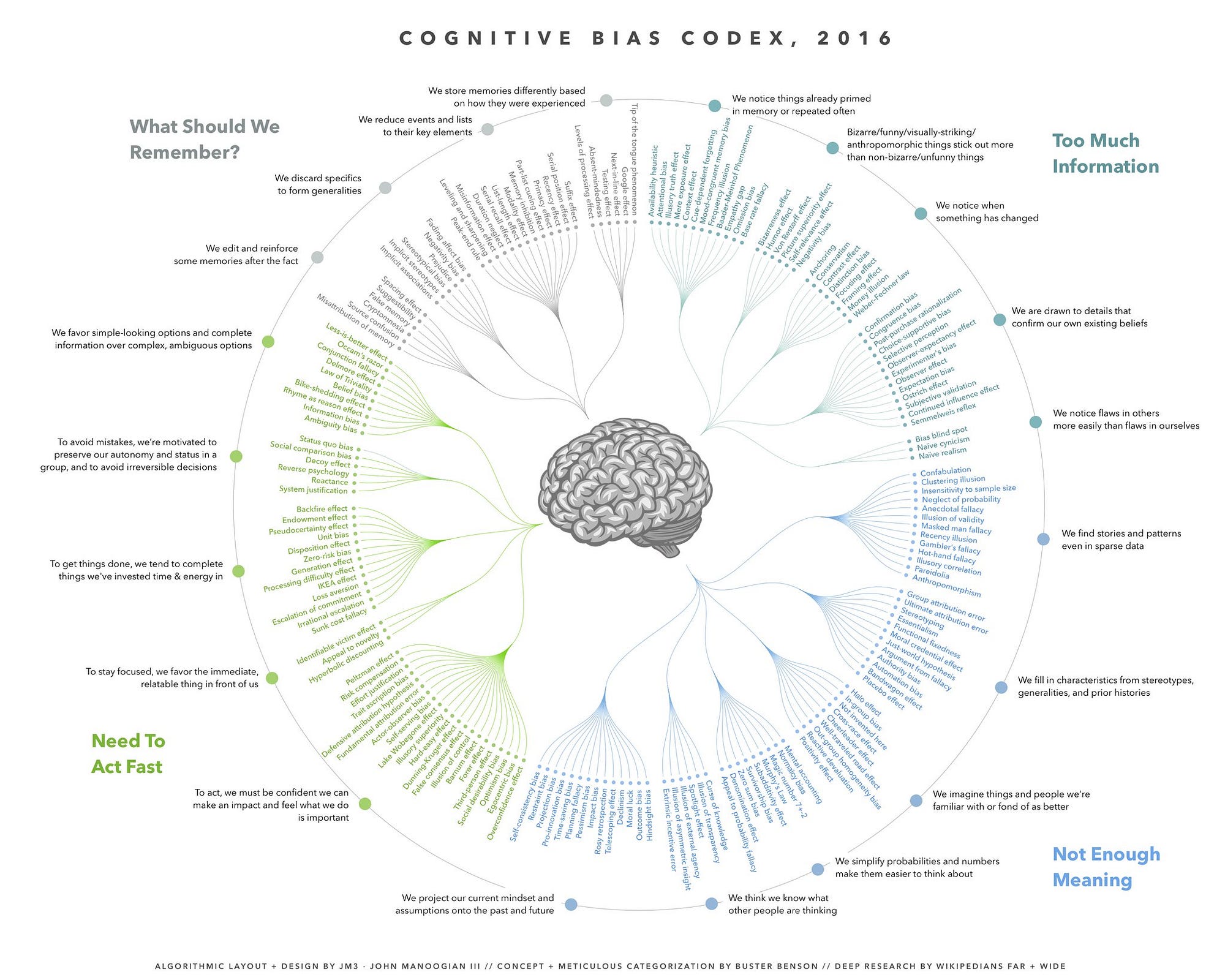
Choose a cognitive bias reply to this thread in a comment with your bias and start working on the Cognitive Bias Primer (everyone should have a different bias)
Buster Benson categorized cognitive biases into 4 major categories and 20 sub-categories.
r/modesofinquiry • u/EngagedBrain • Aug 31 '17
Please reply to this thread with two questions that you have. You may find that the site gives you a message about posting too much. For new accounts, it limits the rate at which you can post to prevent spamming.
r/modesofinquiry • u/EngagedBrain • Aug 30 '17
Follow the link to the Harvard website to take two tests. Please make sure to take the Race one as one.
r/modesofinquiry • u/EngagedBrain • Aug 30 '17
Please give a definition and examples outside of the book for the following:
r/modesofinquiry • u/EngagedBrain • Aug 28 '17
Topic Organizer #disucssion #inclass #aging #ageism
At what age does one become an adult?
Does age matter in relationships?
Should we increase the age of retirement/social security?
Ageism